
Search Engine Positioning: What It Is & How to Improve It
Learn what search engine positioning (SEP) is and how to improve your rankings on Google's first page. I share practical strategies for better visibility and traffic.
Sadiq Saleem
6/2/20268 min read
I've been working in SEO field for over five years now, and there's one question I get more than any other: "How do I get my website to show up on the first page of Google?"
That question right there? That's search engine positioning (SEP) in short.
What Is Search Engine Positioning?
In simple, Search engine positioning is where your website appears when someone searches any query related to your business. It's the particular position your site holds in search results.
Now, here's the thing that most people confuse this with traditional SEO. While SEO is about making your entire website better for search engines, positioning is laser-focused on one objective that gets your pages to rank as high as possible for the keywords that are related to your business.
You can also think about your own behavior online. When was the last time you scrolled past the first page of Google? Exactly. Research shows that the first result on Google gets almost 30% of all clicks. By the time you reach page two, you might as well be invisible.
That's why SERP positioning is very important. It's not just about being online rather than it's about being found.
Why Should You Care About Your Position?
Here's something I tell every client I work with that your position in organic search results directly impacts how much business you get.
When your website ranks in those top three spots, you're not just getting more traffic. You get people who actively look for what you offer. These aren't random visitors—they're potential customers having targeted search intent.
And there's also a trust factor. People naturally assume that websites ranking higher must be more credible and authoritative. It's psychological. If Google trusts you enough to put you first, users will too.
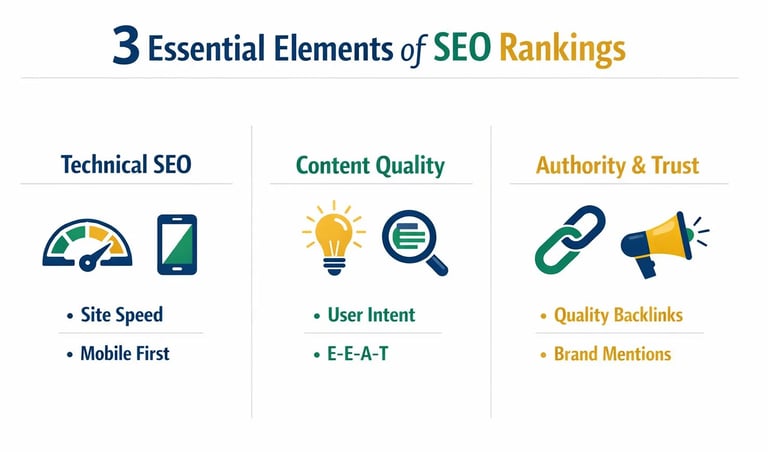
3 Essential Elements That Control Your Position
Alright, let's get into what really determines where you rank. I tell you the three main areas, and you need to work on all of them—not just one or two.
1. Technical SEO
Your website needs to be technically good. I'm talking about things that happen under the hood but the stuff users might not see directly but that search engines absolutely care about.
Site Speed Is More Important Than You Think
Have you ever clicked on a website and just... waited? And waited? And then given up? Yeah, everyone has. Google knows this, which is why page speed is a ranking factor now.
Your pages need to load quickly, especially on mobile devices. Google much cares about your Core Web Vitals like how fast your main content loads and whether things change around while loading. A slow site doesn't just frustrate visitors; it actively hurts your rankings.
Mobile Experience Is Non-Negotiable
Google primarily uses the mobile version of your site to decide rankings now. So if your site looks terrible or loads slowly on phones, you're in trouble. Make sure your design is responsive and works smoothly on all screen sizes.
Keep Your Site Structure Clean
Think of your website like a library. If books are scattered randomly everywhere, nobody can find what they're looking for. Search engines need to understand how your site is organized—which pages are important and how they connect to each other.
Use clean URLs, create a logical navigation structure, and submit an XML sitemap so search engines can crawl your site efficiently.
2. Content Quality and Relevance
This is where a lot of people get it wrong. They either stuff keywords everywhere or write common content that doesn't really help anyone.
You Need to Know What People Really Want
When someone types any query into Google, they have a specific intent. Maybe they're looking for information, products comparison, or ready to buy something.
Your content needs to match that intent. If someone searches "how to improve SEO," they want a guide rather than a sales pitch. If they search "buy running shoes Dubai," they want product pages, not a blog post about running.
I always check the current top-ranking pages for any keyword I want to target. What format are they using? How detailed are they? That tells me what Google thinks users want for that search.
You Must Create Content That Helps People
Google's guidelines talk about E-E-A-T—Experience, Expertise, Authoritativeness, and Trustworthiness. It sounds fancy, but it basically means: write from actual knowledge, show you know what you're talking about, and be trustworthy.
Don't just regurgitate information that's already out there a thousand times. Add your own perspective, real examples, and genuine value. If your content doesn't help someone solve a problem or answer a question better than what's already ranking, why would Google promote it?
You Must Use Your Business Keywords Naturally
Yes, you need to use your target keywords. But please, for the love of all that's holy, use them naturally. Put your main keyword in your title, in some headings, and throughout your content where it makes sense.
Also, don't just repeat the exact same keyword over and over. Use variations and related terms. If you're writing about "SEO services," also mention things like "search optimization," "organic ranking," and "search visibility." Google understands context now—it's not 2010 anymore.
3. Authority and Trust
This is the part that takes time but makes a huge difference. It's about building your reputation across the web.
Backlinks Are Still Important
When other websites link to yours, it's like they're vouching for you. Not all links are equal, though. A link from a respected industry publication is worth way more than a hundred random directory links.
You need to prioritize earning links from quality sources that are relevant to your industry. Just create content so valuable that people naturally want to link to it. Or reach out and build genuine relationships with others in your field.
If you want to build your link profile in the right way, you need to know the netlinking strategies that are more effective.
Brand Mentions Are Essential In This LLM Era
Even when sites mention your brand without linking, Google and LLM notices. The more your brand name appears across the web in a positive context, the more authority you build.
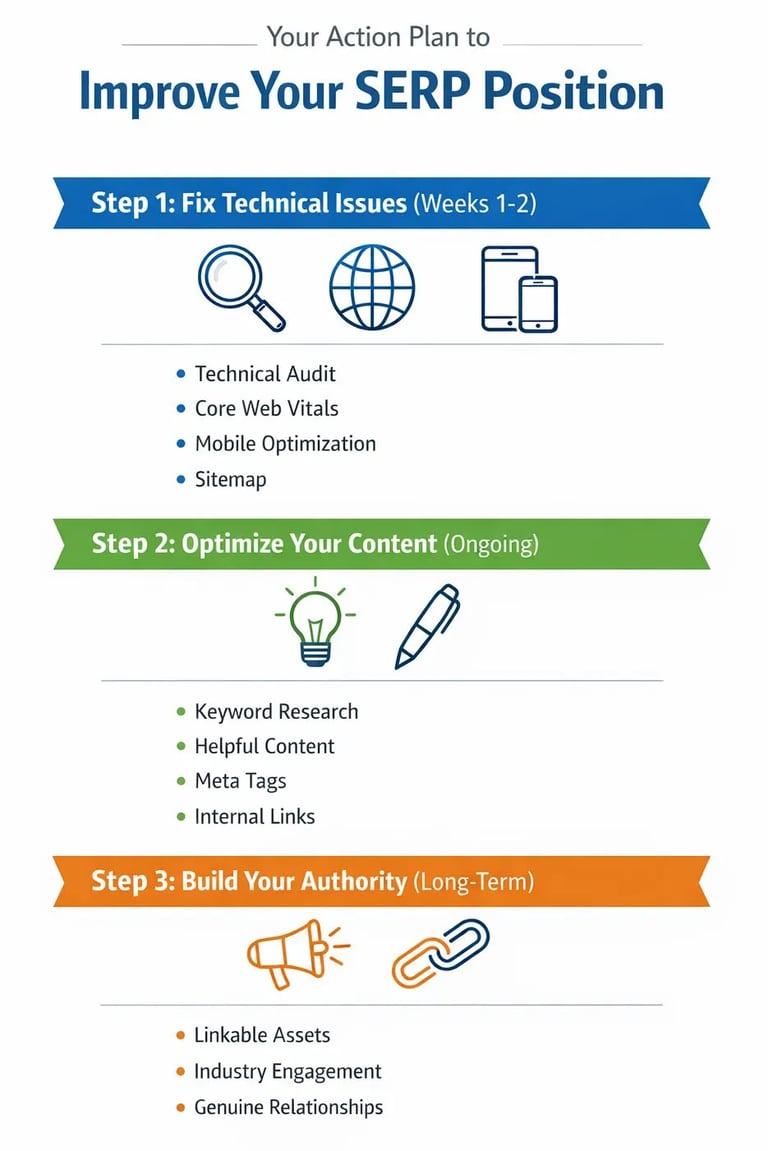
Your Action Plan to Improve Your SERP Position
I will give you a step-by-step practical roadmap. You don't need to do everything at once, but you do need to be consistent.
Step #1: Fix Technical Issues First (Weeks 1-2)
You can start with a technical audit. Use Google Search Console and it's free and tells you in detail what Google sees when it crawls your site.
Check your Core Web Vitals. Test your site on mobile. Make sure you have a proper sitemap submitted and that important pages are actually getting indexed.
If you're working in competitive markets like Dubai, where businesses are constantly fighting for visibility, having technical fundamentals right is even more essential.
Step #2: Optimize Your Content
For every page you want to rank, you must consider these points:
Research what's currently ranking for your target keyword
Write content that's more helpful and comprehensive than what's out there
Optimize your title tag and meta description to include your keyword and be clickable
Use clear headings that break up your content and include relevant keywords
Add internal links to other relevant pages on your site
Remember, optimization isn't a one-time process. Your top competitors are constantly improving their content, so you need to keep yours fresh too.
Step #3: Build Your Authority (Long-Term Strategy)
Start creating content that others actually want to link to. This could be original research, comprehensive guides, useful tools, or insightful analysis.
Then get it in front of the right people. Share it in industry communities, reach out to relevant websites, and build genuine relationships. Don't spam people with link requests—nobody likes that.
Also, engage with your industry. Comment on relevant articles, participate in discussions, and establish yourself as a knowledgeable voice. This naturally leads to mentions and links over time.
Position Isn't Just About Rankings
As per my years of experience, you must know that rank on the Google first page is great, but staying there is where the real challenge lies.
Search engine positioning isn't a destination but it's an ongoing process. Google's algorithm is continuously evolving. Your competitors are persistently trying to outrank you. User search behavior changes over time.
What worked to get you to position three today might not keep you there in six months. You need to monitor your rankings, analyze what's changing, and adapt your strategy accordingly.
But when you build a solid foundation i.e. fast site, valuable content, and genuine authority, basically you create a valuable asset. You're not just chasing rankings; you're building a digital asset that serves your business long-term.
Here's The Common Mistakes That Kill Your Position
Let me save you from some headaches I've seen others go through:
Ignoring User Experience: Your site might be technically perfect, but if it's confusing to navigate or hard to read, people will leave. And Google tracks that through metrics like bounce rate and time on page.
Targeting the Wrong Keywords: Don't just go after the most popular keywords in your industry. Target terms that your actual potential customers use—even if they have lower search volume.
Neglect Mobile UX: I can't stress this enough. If your site doesn't work well on mobile, you're shooting yourself in the foot.
Buying Links: Seriously, don't. Google has gotten really good at detecting paid link schemes, and the penalties aren't worth it.
Write Only for Search Engines: Your content needs to satisfy both search engines and actual humans. If you write only with SEO in mind, it usually ends up reading awkwardly and not converting visitors.
Time and Expectations
You must keep in mind that search engine positioning takes time. If someone promises to get you to number one in a week, they're either lying or using black-hat tactics that'll get you penalized.
Typically, you might start see position change in 4-8 weeks for less competitive terms. For highly competitive keywords, it could take several months of consistent effort.
Once you start ranking well for your business queries, the results multiplies. You get more visibility, which leads to more traffic, which can lead to more links and brand mentions, which further improves your position.
My Final Words
Search engine positioning isn't a difficult task, but it does require strategy, consistency, and patience. You need a technically solid website, content that genuinely helps people, and authority that shows you're trustworthy.
You must prioritize to create real value for your audience first, and then rankings will follow. Search engines are becoming better at understanding quality content and rewarding sites that genuinely deserve to rank.
If you're running a business in competitive markets or need specialized approaches for your region, working with professionals who understand the local landscape can accelerate your results significantly. The key is finding the right partner who focuses on sustainable, ethical practices rather than quick fixes.
You can start with what you can control today that means fix technical issues, improve your content, and begin building relationships in your industry. Your position will improve as you consistently execute on these fundamentals.
You need to remember that your competitors aren't standing still. The only way to maintain and improve your position is to stay committed to the search engine optimization process. Make SEO positioning part of your long-term business strategy, not just a one-time project.
Now, go check where you rank now for your target keywords and start doing improvements. Your spot on page one is waiting.
Hire Your Reliable SEO Expert in Dubai, UAE
With 5+ years of digital marketing experience, I provide you the effective and affordable SEO services to grow and skyrocket your business.
FOR EXPERT SEO ConsultaNCY
HIRE #1 TOP RATED & trusted SEO GUY
contact@sadiqsaleem.com
© 2026. All rights reserved.
Quick links